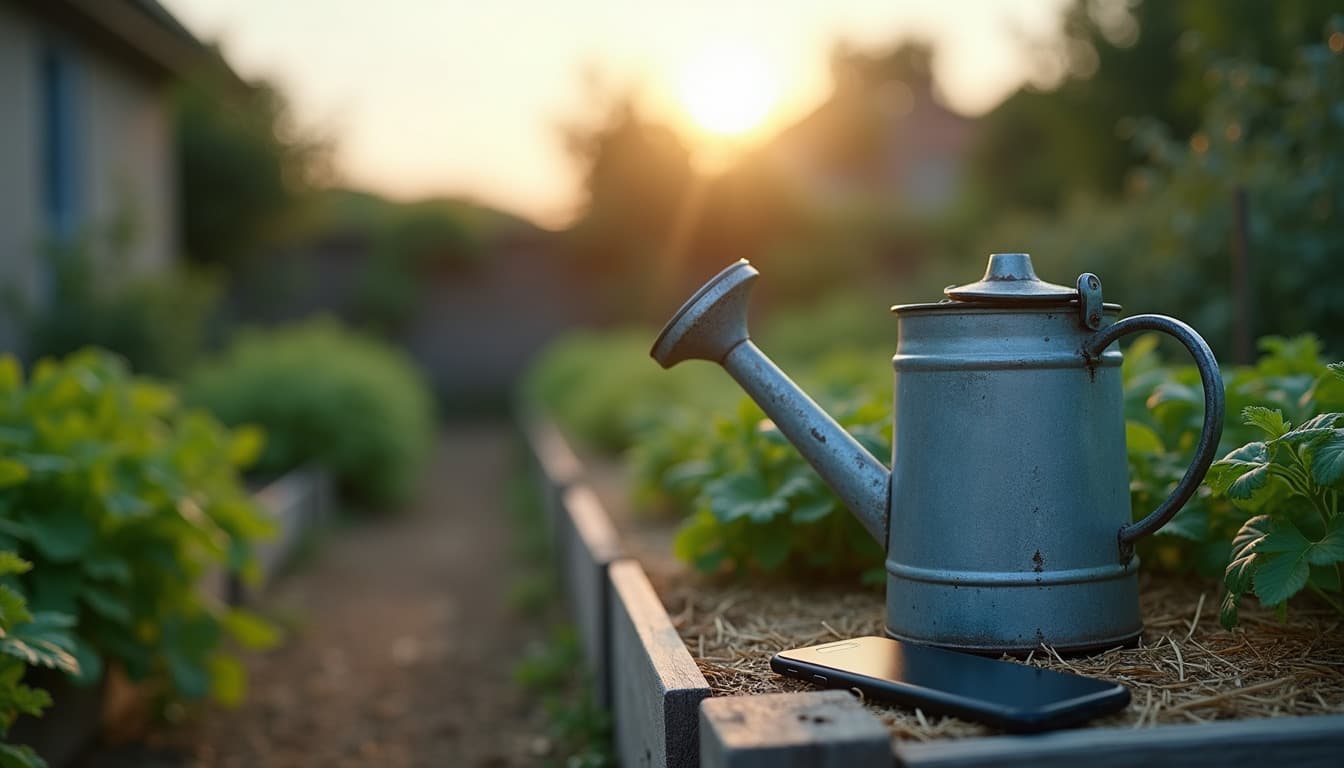
The best time to water the garden is early in the morning, at the foot of the plants. A deep soak once or twice a week beats a sprinkle every day. Before watering, push a finger into the soil: if it is dry a few centimetres down, the garden is thirsty. More than 10 mm of rain lets you skip a watering, mulch spaces watering out, and pots dry out far faster than open ground.
Morning or evening: what actually happens
Early morning, before the sun heats things up, is the safest time. The soil is cool, the water has time to sink towards the roots before the heat, and whatever wets the leaves dries off during the morning. Foliage that stays damp all night encourages fungus, which is the main reason gardeners prefer the morning.
Evening is still a good option in a heatwave, when the soil is scorching by 10 a.m. The water has the whole night to soak in and almost none of it evaporates. Two precautions: water at the base without wetting the leaves, and remember that slugs love damp soil at dusk.
The only bad time is the middle of the day in full sun. A good share of the water evaporates before it reaches the roots: you pour a lot for very little effect.
How often to water a vegetable garden
The rule that works almost everywhere: less often, but more. A deep watering sends water down into the soil, and the roots follow it. A small daily sprinkle only wets the surface, the roots stay shallow, and the plant suffers on the first hot day.
For vegetables in open ground in summer, aim for roughly 10 to 20 litres per square metre each time (about half an inch of water), once or twice a week. Your soil shifts that figure:
- Sandy or stony soil holds water poorly. Water a little more often and a little less each time.
- Clay soil holds water for a long time but drinks it slowly. Water gently, in several passes, and less often.
- Seedlings and fresh transplants still have short roots. Light, regular watering until they settle in, then space it out.
- Trees and shrubs planted a few years ago: rarely, but generously, at the base, during long dry spells.
A lawn can turn brown in midsummer without dying. Most grass greens up again with the autumn rain, so it is often the first thing you can stop watering.
How to tell if the soil is thirsty
The calendar tells you little, the soil tells you everything. The simplest test: push a finger into the ground at the foot of a plant, a few centimetres deep. If the soil is cool and slightly sticky, wait. If it is dry and dusty, it is time. To be sure, dig about ten centimetres down with a trowel: that is where the roots drink.
A plant that droops at the end of a scorching afternoon is not necessarily asking for water: squash and cucumbers do it to protect themselves from the heat. Look at it the next morning. If it has perked up overnight, all is well. If it is still wilted when you get up, it is thirsty.
Old gardeners sum up the rest with a saying: one hoeing is worth two waterings. Breaking the crust on the surface after rain or watering helps the water get in and keeps it there longer.
What the last few days of rain change
One figure worth remembering: 1 millimetre of rain is 1 litre of water per square metre. A 2 or 3 mm shower barely wets the surface and does not replace a watering. From about ten millimetres, the soil is moistened in depth and the next watering can wait.
That is why it helps to know what actually fell in your own garden, not just in the next town. A rain gauge in the middle of the garden tells you to the millimetre. After a week without rain in warm weather, nearly the whole vegetable patch needs water; after a heavy storm, you can often skip a turn.
Mulch to water less
Mulching is the step that saves the most water. A layer of 5 to 10 cm of straw, dead leaves, wood chips or well-dried grass clippings at the foot of the plants limits evaporation, keeps the soil cool and holds back weeds. Waterings become noticeably less frequent.
Two tips for it to work: mulch on soil that is already moist, just after rain or a good watering, and spread grass clippings thinly so they do not ferment. When you water, push the mulch aside a little to check the water really reaches the soil.
Pots versus open ground
A pot only has the soil you give it, and its sides heat up in the sun. In midsummer, a south-facing window box can need water every day, when the same plant in the ground would last three or four days. Terracotta dries faster than plastic.
For a pot, water until it runs out of the drainage hole, then empty the saucer after half an hour: roots that sit in water all the time rot. And if the compost has shrunk so far that water runs straight down the sides, stand the pot in a bucket of water for a few minutes.
In summer, check the watering restrictions
During droughts, many places limit garden watering. In the UK, water companies can impose a hosepipe ban; elsewhere, towns and regions set watering days, banned hours or a full ban during a severe drought. The rules change from one area to the next and over the course of the summer, so check with your water supplier or local council. Watering early in the morning, at the base, on mulched soil is exactly what lets you live within those rules.
What XNeuronal does
XNeuronal is an app that remembers what you tell it and comes back to you at the right moment. It can also keep an eye on the weather for you.
One evening in June, you tell it: "Let me know when a hot day with no rain is forecast at the garden, so I can water the tomatoes." If it does not know the garden yet, it asks for the address. Then it tells you out loud the threshold it has set, for example 28 °C or more and 1 mm of rain at most, so you can correct it straight away ("make it 30 instead") or later, in one sentence.
After that, you stop thinking about it. As soon as a day like that shows up in the forecast, up to three days ahead, you get a notification that gives the forecast figure and repeats your own action: water the tomatoes. The day before, a follow-up arrives. Alerts go out in the morning or early evening, never in the middle of the night.
If a storm ends up in the forecast for that day, the follow-up does not come: it simply stays quiet, with no message to say "never mind". And a week-long heatwave does not ring every morning: by default, it leaves three days of silence between two episodes. If the watch only makes sense in summer, you can tell it to keep watch from May to September only.
Two things to know before you try it. It looks at the forecast for the coming days, not at your soil: it does not know whether you watered yesterday or whether your beds are mulched, and the finger test still has the last word. And the watch runs on our servers: to get the alert as a notification, you need an account and a connection.
Other tools, depending on what you need
- A weather app gives the forecast and often the expected rain hour by hour. You have to remember to open it.
- A rain gauge tells you what really fell in the garden. It is the most accurate measure, read by you.
- A soil moisture sensor pushed into the ground shows the moisture at root level, without digging.
- A smart irrigation timer waters for you, and some models can skip a cycle when it rains. For automatic watering, it is the right tool: XNeuronal turns on no tap, it lets you know.
Going further
For things to do when you arrive somewhere, the article on a reminder at the right moment shows how to tie a reminder to a place instead of a time. And empty your head without sorting a thing explains how to say everything at once and let XNeuronal file it.
The features themselves are described on the weather reminders and reminders and calendar pages.